



What you will learn
Classical economics linked savings to growth; why John Maynard Keynes challenged that view; how Modern Monetary Theory (MMT) explains that spending creates income and savings; and why there is no fixed pool of savings.
Keywords: Modern Monetary Theory (MMT); private sector savings; government spending; economic growth
Understanding savings, investment and growth
Ok, it’s time I got back to some MMT basics. This week, as I’m sure you’ll be happy to hear, I’m going to discuss the role of private sector savings as they relate to economic growth. I will start with classical era economists, work my way past the ideas of Keynes and finally land on the MMT view - on savings and growth. Let’s get started.
Frugality has always been thought of as a virtue, an idea with its roots in religion and social norms.
But ‘saving for a rainy day’ took on a new status with the rise of the classical school of economics in the late 18th and early 19th centuries.
Economists like Adam Smith, Jean-Baptiste Say and David Ricardo built theories in which a sensible citizen was a frugal citizen: saving was not just a virtue, it was seen as underpinning economic growth.
In short their story was: savings, including profits and capital accumulation, are good; they lead to investment and that investment leads to growth.
These ideas were later formalised by the late 19th/early 20th century neoclassical economist Alfred Marshall, who turned them into a more formal mechanism.
His version of the ‘savings are good’ idea went as follows: when people save more, interest rates fall; lower interest rates encourage more borrowing and investment; and greater investment leads to greater productive capacity in the economy.
Why did Marshall think that more savings meant lower interest rates? Simple demand and supply: if more funds are available the cost of borrowing those funds goes down.
If funds were scarce it would be the opposite: the same number of borrowers chasing a smaller pool of funds pushes up the price of those funds.
Marshall laid the foundations for what later became known as the loanable funds theory. That is, saving is assumed to provide the pool of funds from which investment is financed, with the interest rate adjusting to bring the two into balance.
John Maynard Keynes comes along and turns the savings theory upside down
The ‘savings are good’ idea lasted into the early 20th century until Keynes came along (responding to the problems of the Great Depression) and knocked it into a cocked hat with his own simple logic.
Savings, said Keynes may well be a great idea for the individual but it is a disastrous idea for the economy as a whole.
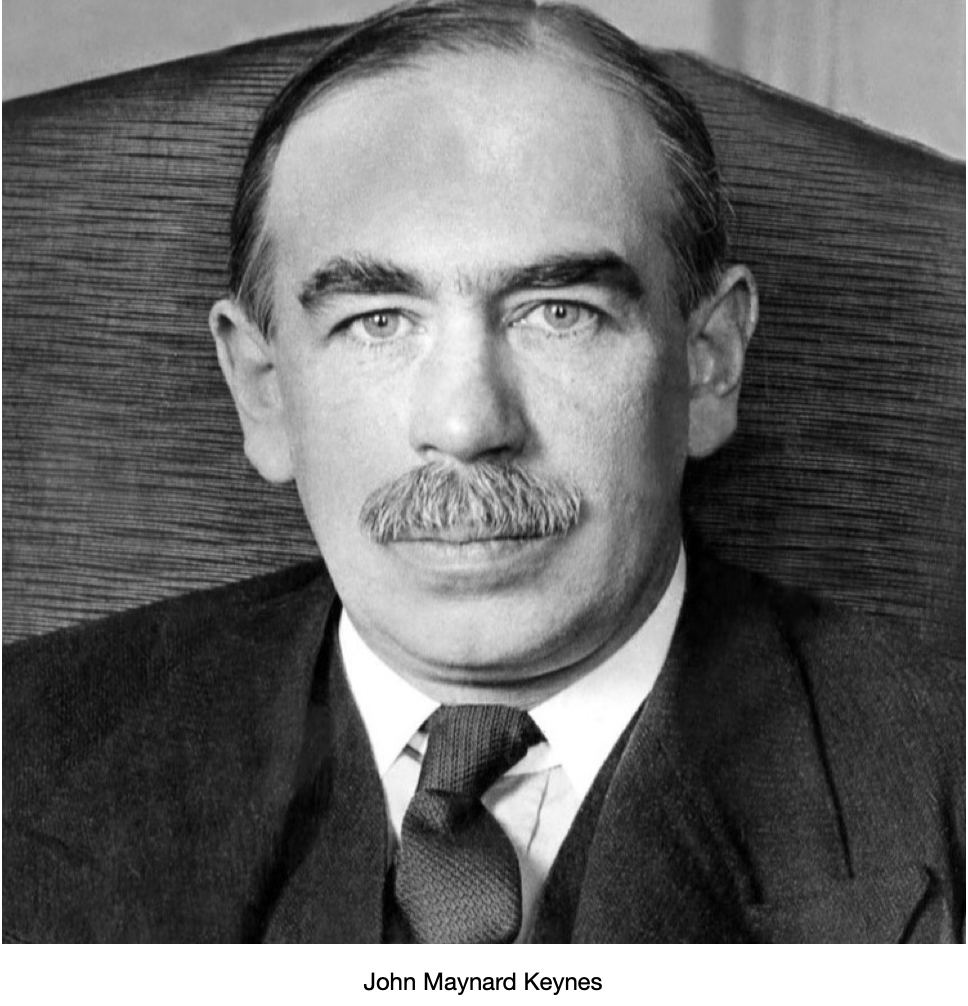
This is the ‘paradox of thrift’ Keynes outlined in his General Theory of Employment, Interest and Money, published in 1936.
He explains it in the following way: if everyone is saving, they are not spending and if they are not spending, that means less demand for goods and services.
Businesses will, therefore, cut back, release workers and hold off on further investments. Those workers, who have been ‘let go’, now have less income and will reduce their spending accordingly. This creates a downward spiral of spending, investment and production.
Among other things, Keynes tells us two things: firstly it is not saving (when not matched by spending) that governments should be encouraging; it is spending. And secondly, the thing that causes growth is an increase in what he called ’aggregate demand’.
[By aggregate demand he means total planned spending on all finished goods and services within an economy: consumption, investment, government spending, and net exports.]
The question then becomes, how do you increase aggregate demand.
For Keynes’ the solution was obvious: when private sector spending is weak, the government must step in and fill the spending gap. In this scenario, only the government has the ability and the capacity to spend in a way that can boost aggregate demand.
So, looking back from where we are today: we can see that, although in the first half of the 20th century, there was large-scale expansion on infrastructure due to war spending, the application of Keynes logic also led to a huge increase in post-war government spending: as the government spent on schools, on public housing and other public works.
We can also see that there was also an expansion of social spending and welfare programmes. Keynes provided the financial confidence a free health service, as outlined in the Beveridge Report was ‘affordable’.
However, in terms of the arc of our story, I must mention that Keynes continued to frame this as if the government needed to borrow from the private sector in order to put idle resources to work.
The MMT approach presents a clear paradigm shift: it points out that, contrary to the orthodox story, the government does not need to borrow private savings. Why? Well, because, as the monopoly issuer of the currency, it creates the money the moment it spends it.
New on MMT101: MMT online training course – from first steps to advanced
If you want to learn MMT from the ground up, take my MMT online training course, MMT101 – The Why, The What and The How of Modern Monetary Theory. Paid subscribers get access at no additional cost – just message me.
MMT tells the story from a different perspective: viewing the economy in accounting terms
MMT largely agrees with Keynes’ ‘aggregate demand’ story. However, MMT frames it in accounting terms, borrowing idea from Keynes, while combining those ideas with economist Wynne Godley’s sector balances analysis, and Abba P. Lerner’s ‘Functional Finance’.
The sectoral balance approach shows that one sector’s spending must be another sector’s income: and equally, one sector’s deficit is another sector’s surplus.
We can use that simple idea to illustrate an important point about ‘where government spending goes’.
Over the last three hundred years, the UK Government has mainly run deficits (as do most governments), which tells us that the non-government sector has been running a net surplus.
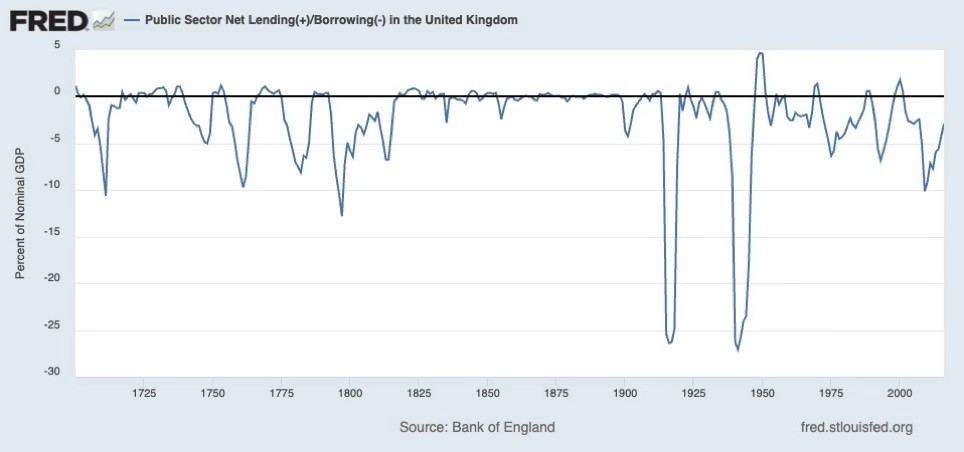
In other words over time money has, in net, flowed from the government sector into the non-government sector.
And in the UK, the reality is, that most of that money has ended up in the private sector. This is an important point in relation to where private sector savings come from.
If you have some spare change, please become a paid subscriber to help me continue producing these educational MMT articles.
MMT notes that private sector savings are important
MMT is not saying that private sector savings are not important. The private sector individuals, businesses and organisations have a desire to save, particularly when the economy feels fragile and they are worried about the future.
However, unlike the classical economists, MMT’s approach takes balance sheet approach and the balance sheet shows us that it is not savings that are driving income and growth.
It is spending that creates the income from which savings are made; on a balance sheet one person or entities spending is always matched by another person or entities income.
For the private sector, government deficits play a central role in sustaining that income, it is the accounting source of the net financial wealth that allows the private sector to save.
Put simply: spending comes first. The government must spend the currency into existence before the private sector has anything to put away for a rainy day.
Government spending does not crowd out private sector investment
MMT points out that the government’s ability to spend is not constrained by taxes or borrowing in its own currency.
In reality, all government spending is new money, issued by typing figures directly into commercial bank accounts for the purpose of paying for goods and services.
Those numbers being typed into bank accounts are not a reflection of any existing commodity or any financial assets that the government holds.
No big pile of tax money is used as a revenue source and the government does not need to borrow from the private sector via bond sales to get its spending money.
So, where does the value of the governments currency come from?
The value of the government’s currency is based on the fact that the government ‘backs it’ and that citizens must pay their taxes in it.
Money is anything that is accepted as payment:
Government money is the ultimate version of that simple statement. Just as in the past the local farmer saw value in accepting the King’s Tally Stick - which was a piece of wood with notches on it - today we accept the government currency, in whatever form, as being something we can use to buy goods and services.
MMT shows that the loanable funds theory is wrong
So, if government spending does not involve removing money from private sector bank accounts - and private sector banks don’t give loans by dipping into existing savings - then it is simply not possible to say that government spending crowds out private sector investment.
By highlighting how both governments and commercial banks actually work (those commercial banks with reserve accounts at the central bank), MMT undermines the ‘loanable funds theory’.
The loanable funds theory assumes that banks lend out pre-existing savings - they don’t. In reality, banks also just type figures into customers’ accounts when they create loans.
The extent to which commercial banks can create loans is driven by the availability of creditworthy borrowers, the bank’s own capital adequacy and profitability—it is never constrained by customer savings or the existing supply of central bank reserves, which are always provided to the system as needed.
The difference between commercial bank loans and government spending is that only the government can add net new assets to the private sector.
Government ‘debt’ can remain on the government’s balance sheet for ever; that ‘debt’ does not curtail current or future spending. Commercial bank loans, on the other hand, have to be paid back.
In conclusion, there is no fixed pool of funds for government and the private sector to compete over.
Higher levels of savings do not lead to lower interest rates and higher investment
MMT also challenges the idea, set out in classical and neoclassical economics, that higher levels of saving lead to lower interest rates and, therefore, to higher levels of investment.
In short, MMT shows us that interest rates are not determined by the supply of savings in a market for loanable funds. They are a policy variable set by the central bank. And investment is not constrained by prior saving. Businesses invest when they expect to make a profit, not because there is a larger pool of savings available.
Conclusion: private sector savings don’t drive growth, spending does
In this article, we have taken a journey from the classical view of savings as essential for investment and growth, through Keynes turning that idea on its head, and finally to the MMT view derived from the observation of what happens in practice as revealed by balance-sheet accounting.
Yes, private sector savings are important but they don’t drive investment and growth. It is spending that creates income and it is that income which allows savings to happen.
Savings are the result, not the cause, of a healthy economy.
If you have any questions or if you disagree with anything I write, I want to hear from you. Please add your comments in the discussion area. Contrary views are welcome.
This newsletter has become my only work, and at the moment it isn’t paying enough to be sustainable. What I need now is for more people like yourself who are interested in economics and in particular MMT, to take the step of becoming paid supporters. For the cost a single cup of coffee a month you allow me to keep writing, keep teaching, and keep this project alive. Thanks.
Thanks to all of you who have helped to keep MMT101 going.

Resources
The Wealth of Nations by Adam Smith (1776) – Specifically his chapters on “parsimony” (frugality) as the source of capital.
Principles of Economics by Alfred Marshall (1890) – The foundational text for the “Loanable Funds” theory and how interest rates balance supply and demand.
The General Theory of Employment, Interest and Money by John Maynard Keynes (1936)
Social Reform and the Theory of the State (The Beveridge Report, 1942)
Seven Deadly Innocent Frauds by Warren Mosler
The Deficit Myth by Stephanie Kelton
Macroeconomics by Mitchell, Wray, and Watts
Links to some of my most popular newsletters
My MMT Top Ten: Modern Monetary Theory’s Best Ideas Explained
Important Figures in the Development of MMT: Abba P. Lerner ‘Functional Finance’ - Jim Byrne
Become a paid subscribers for access to additional content:
A Permanent Home for MMT101 Paid Subscriber Resources – Factsheets, book recommendations, academic papers, MMT podcasts and more.
MMT Factsheet 3: If Taxes Are Not For Spending What Are They For?
Another great piece, thank you Jim.
I realize the thrust of this is solely about the availability of money, but perhaps statements like this need to be used with care:
> "...then it is simply not possible to say that government spending crowds out private sector investment. "
MMT would encourage us to think about this in terms of real resources, where it is indeed possible for government spending to crowd out private sector access to the labour, energy, materials, etc needed for business investment.
You took a simple truth that most economists get backwards and laid it out in plain language. The sequencing described in the article is the opposite of what most of us were taught, but once you see it, you cannot unsee it. The old story about savings fueling investment feels like a magic trick that has been explained. You can still see how people believed it, but you also see why it was never true.