


The idea of sectoral balances is simple, yet many people find it difficult to get their head around it. I know that because I found it difficult myself when first encountering it.
I think maybe I was thrown by the name. If there were prizes going for the most opaque piece of economic jargon ‘sectoral balances’ would be my winner: without context the phrase means nothing.
So, my aim in this article is to reveal its simplicity and in the process convince you of its power. But don’t worry, this is not going to be a complex, data filled post: in fact, it only has two sections:
Firstly, I will gently guide you through the basics ideas from simple analogy to real world application.
And secondly I will demonstrate why understanding this simple idea makes the conventional view of ‘the dangers of our national debt’ sound both absurd and, a worst, criminally negligent.
Let’s get started.

1. Get the cups from the cupboard - we’re going out to play
Before we start I will do two thing: firstly, define the word ‘sectoral’ (in the phrase sectoral balances) and secondly, I’ll let the cat out of the bag by revealing two main insights that the sectoral balances approach gives us.
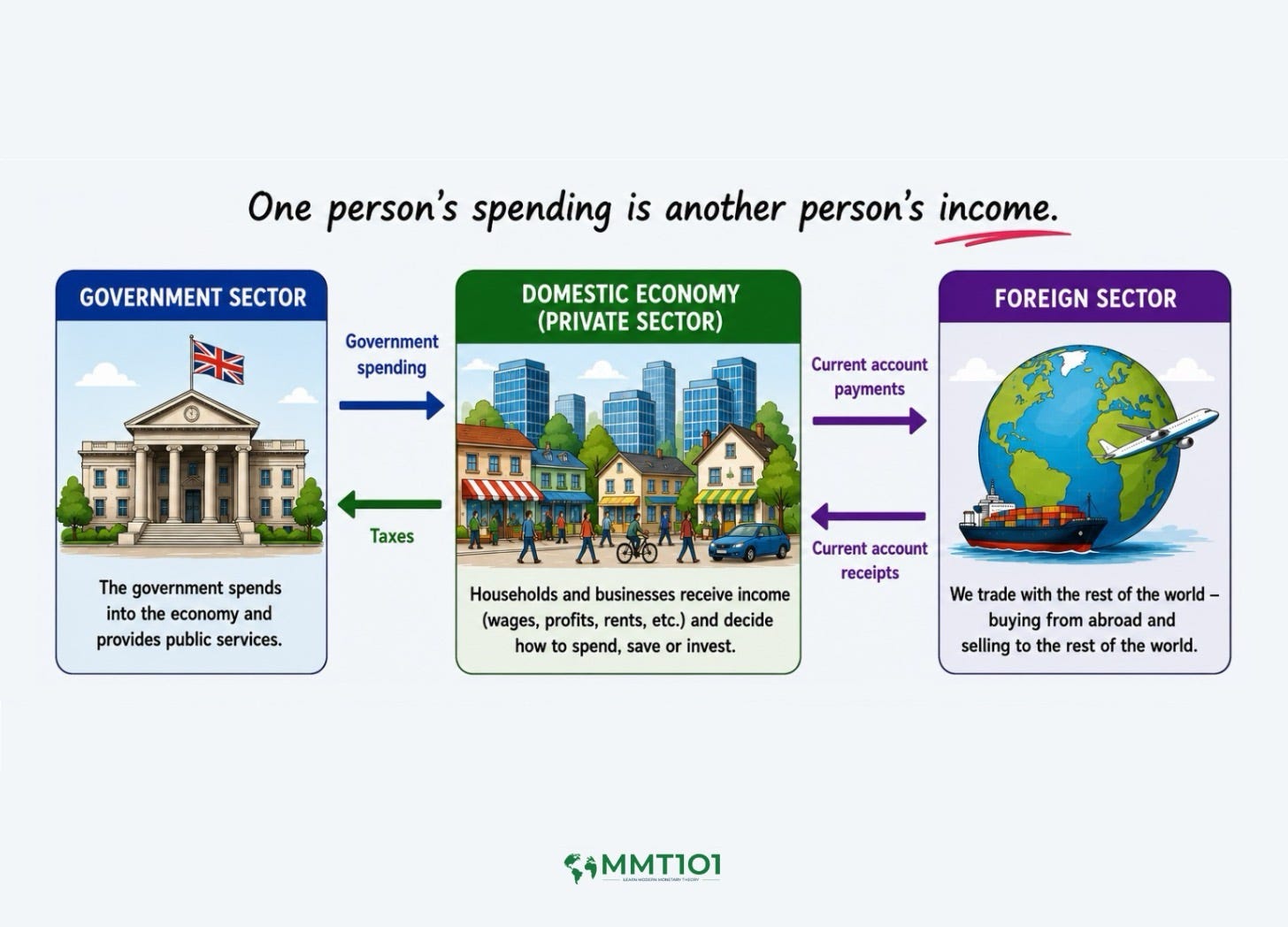
Sectoral refers to the three economic sectors: the government sector, the private sector and the foreign sector.
The core insight of the sectoral balances idea is that ‘one person’s spending is another person’s income’.
Just let those two points rattle around your head for now. At this point I suspect you will be thinking that this supposedly important insight sounds a bit inane (you wrote a whole article just to tells us that Jim - do you have nothing better to do with your time?).
However, I’m confident that your brain will reveal the importance of the latter point in this article, or at some time in the future: perhaps when you are walking in the park or riding the train to see your favourite band (or work or to see a friend).
Having planted those ideas in your head, we’ll take a step back to establish the basic logic that is at the heart of the sectoral balances idea.
Open your cupboard door, take two cups out and put them on your table. Fill one of them with water.
You have two cups on your table, cup A and cup B. Cup A is full, cup B is empty.
Now, pour half of the first cup into the second cup.
Cup A has lost half of its contents and cup B has gained the same amount. Note that no water has been lost and no water has been gained.
Bear with me, you might be feeling irritated by the simplicity or my explanation - but we’ve established an important point: no matter how much water you pour from one cup to the other: the respective amounts always add up equal to the original amount, i.e., the amount that was originally in cup A.
Ok, we’ve got that simple idea established. Let’s go to the next step. Grab another cup from the cupboard and put that on the table.
We now have three cups. Pour half of the water from cup B into what we’ll now call cup C. Again, the amount of water has not changed; it’s now just split three ways.
Pause for a second, reread that scenario again, to ensure you’ve grasped that insanely simple idea; the same amount of water is now split across the three cups. In truth, it feels like no one could misunderstand that: but as we’ll find out later, in the real world there are those who appear to miss this simple logic.
Three cups, three sectors of the economy
Ok, pour the water down the sink. Next, instead of water, put ten one pound pieces into cup A1. You’ll probably find them in the drawer next to the front door - where you keep change to give the delivery man or woman a tip.
Cup A represents the government, cup B represents the private sector and cup C represents the foreign sector.
What happens if the government sector cup ‘spends’ 5 pounds into the private sector cup?
Simple, we now have 5 pounds in the government’s cup and five pounds in the private sector cup.
Overall nothing has been added, nothing has been lost: both add up to the original amount.
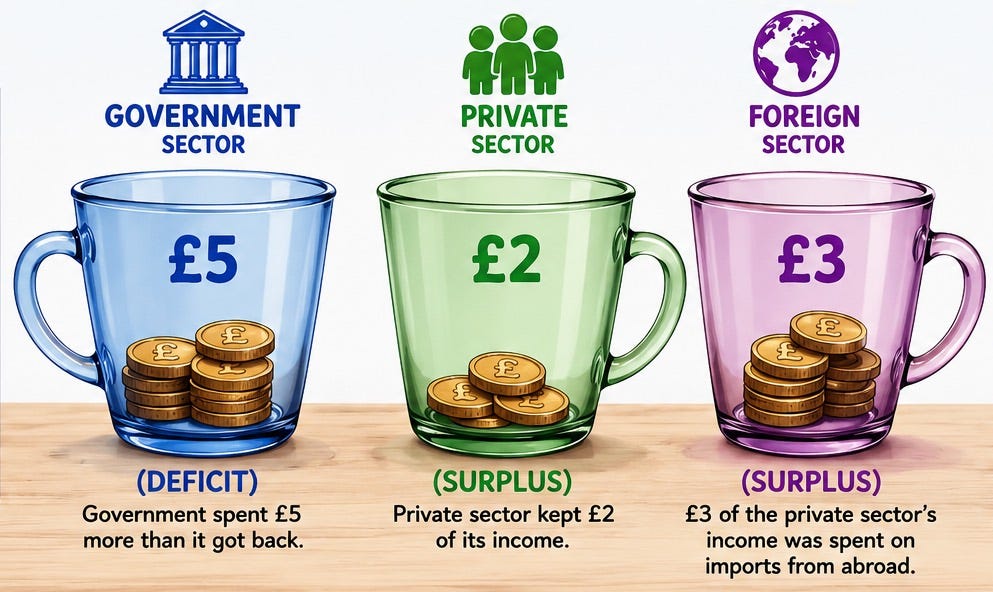
Now what happens if the private sector spends 3 pounds to buy a tremendously cheap car from the foreign sector (say China, because we know they are now making the best cars. Controversial opinions are my speciality)?
The government sector still has five pounds, the private sector has two pounds and the foreign sector has 3 pounds.
Once again, nothing has been lost. 5 + 2 + 3 still equals our original ten pounds from the drawer.
It’s time to revisit one of our original bullet points from the start of this journey
The core insight of the sectoral balances idea is that ‘one person’s spending is another person’s income’.
The government has spent five pounds into the non-government sector. And, the non-government sectors – which is made up of the private sector and foreign sector – has gained five pounds:
We’ve gained our first real-world insight: the government sector’s spending is the non-government sector’s income.
Deficit and surplus, defined
Ok, it’s time to add some economic jargon:
Defining the word ‘deficit’: a government deficit is the term used when the government spends more into the economy than it takes back in taxation (within a particular time frame, usually one year).
In our simple example what is the current government deficit?
Well, it’s five pounds, the amount it spent into the private sector but not yet taxed back. The government is running a deficit of five pounds.
Defining the word ‘surplus’. We know that the amount the government cup spent must equal the amount that has ended up in the other two cups, i.e., the private sector and the foreign sector.
So if the government has a five pound deficit, what’s the level of the non-government sector surplus? Well that must also be five pounds.
A surplus just means that a sector has gained; in accounting jargon we would say that it has a surplus on its account.
In this closed system, if we think of deficits as negative and surpluses as positive, when we add them up what do they add up to? Yes, they add up to zero.
The government is minus five pounds and the non-government sector is plus five pounds. Plus five plus minus five equals zero.
What happens when the private sector has to borrow?
I’ve got one last question for you. What happens if that cheap car ended up costing six pounds rather than three?
In the real economy, when that happens it means the private sector has to find the extra pound from somewhere? And that usually means it has to borrow. The private sector borrows the extra one pound it needs from a commercial bank.
Which sectors are now running a deficit?
Well, clearly, the private sector is now in deficit along with the government and the only sector in surplus is the foreign sector.
The government has a deficit of five pounds, the private sector has a deficit of one pound and the foreign sector has a surplus of six pounds.
If you add them all up what does that come to? It still comes to zero.
Ok, let’s put the change back in the drawer and the cups back in the cupboard. I suspect you are getting tired of this game.
It’s time we moved to the real world: the real government, the real private sector and the real foreign sector. Note, that the real world is, unfortunately for us, a little more complex that your kitchen table scenario.
[Note, if both the foreign sector and the government run a surplus the private sector must – following our logic – be running a deficit, to a level that cancels out both.
If the foreign sector continues to run a surplus, the private sector can only be in surplus if the government runs a deficit.]

2. Going from your kitchen table to the real world
This is when we get to the important stuff. We want to know what sectoral balances teach us about the economy and specifically about government spending?
To do that I’m going to take a step back to our original scenario when we only had two sectors (originally in the form of just two cups), the government sector and the non-government sector.
When the government spends into the non-government sector how much of its net spending goes into the non government sector? Well, 100% obviously, because that’s the sector it is spending into.
In relation only to that net spending: how does the size of the government’s deficit compare to the non-government’s surplus? Well, obviously they are the same size (why are you asking such stupid questions Jim?)
Now we split the non-government sector into its two components, the private sector and the foreign sector, so that our example is now reflecting the real sectors of our economy (in relation to the UK). Which is handy, because we are now going to look at that real economy.
Before moving on, let’s look at some real data. The publication, House of Commons Library Research Briefing Public spending: a brief introduction, tells us that when the government spends money, only 2% of it is spent outside the UK (the foreign sector).
Now, if you are doing quick arithmetic in your head, you might think: ‘Ah, so that means 98% goes straight into the private sector!’
Not quite (remember I said the real world is slightly more complex?). Some of that 98% pays for things in the public sector and the public sector is regarded as part of the government.
But here’s the bit that’s easy to miss. When the government pays an NHS nurse or a teacher their salary, it is at that very moment that the money leaves the government sector and goes into the private sector.
The instant it lands in that nurse’s bank account, it is private sector income.
So a very large share of that 98%, wages, pensions, contracts with private firms, becomes private sector income the moment it’s paid out.
It’s already in the pockets of private citizens and businesses (do businesses have pockets, Jim? That’s the first I’ve heard of it).
Finding this useful? Subscribe now – it’s free.
What does that mean in real money?
Before moving on I want to give you a real example of UK government spending.
For the financial year 2024/25 total spending was £1.292 trillion and the deficit (a net injection into the non-government sector) was £153 billion.
These are figures from the UK Parliament, House of Commons Library: The budget deficit: a short guide.
So, the data tells us that:
In 2024/25, virtually all of that £153 billion deficit spending ended up in the domestic private sector.
In other words, that spending mostly ends in the hands of UK citizens and domestic businesses: in the form of infrastructure contracts, state pensions, public sector salaries (teachers, NHS staff…) and so on.
Let’s remind ourselves of that sectoral balances insight I mentioned at the start of this article.
The core insight of the sectoral balances idea is that ‘one person’s spending is another person’s income’.
In this case that ‘one person’ is the government and that other person is us: if we define us as the actors within the private sector. Of course, I am not forgetting that those actors do not just include individuals, they include businesses.
[Note: you may be thinking, ‘but you are forgetting that the private sector spends money into the foreign sector,’ and I would say, yes, that’s true.
But it doesn’t invalidate what I’ve just said. First of all, it came from the government sector: private sector actors then decided how to spend their income (whether wages or payment for a service). Some of which gets spent on purchases from the foreign sector.
Don’t let the idea that the government itself spent only 2% into the foreign sector fool you into thinking that I’m ignoring the much higher figure which results from private sector spending into the foreign sector.
The 2% is just the government’s direct overseas bill; our own collective spending on imports is a completely separate spending event.]
Why is all of this important?
Do we hear politicians, mainstream economists and journalists fretting daily over the size of the national debt? Do you hear them telling us that debt/GDP is dangerously high and unless we pay down some of that debt we are in trouble?
Yes we do hear that story. But whose debt are they talking about and why are they using the word ‘national’ in relation to it?

The deficit myth versus reality
Have we not just learned that when the government sector is in deficit the non-government must logically be in surplus?
Yes, we have just learned that. So what do they mean by national debt?
Do they mean that the government has an accumulation of historic deficits (what they call the ‘debt’) and do they then follow that up with, “but, the last thing we should do is worry, because the non-government sector is in surplus by exactly the same amount.”
I don’t recall them making that qualification. I have a question for those politicians, economists and commentators.
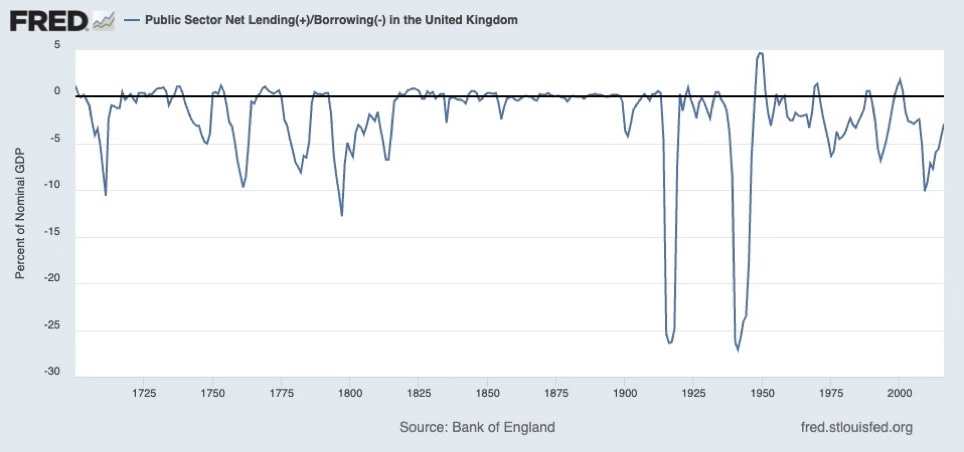
Why are you telling us only one side of the story? Why are you not celebrating 300 years of mostly non-government sector surpluses (private sector savings) instead of 300 years of mostly government deficits?
And importantly why are you not telling us that there is a crucial difference between the debt that you or I might have, and one that a currency issuing government such as the UK or US has?
We always need to find money to pay back our debts, but the government is neither a household, nor a private business.
The crucial difference is that the government issues the currency. That debt (the accumulation of deficits) can sit on its book until the end of time and it will have no impact on its ability to spend, now or in the future.
That’s not to say that the are not things that impact spending decisions. There are: those include, finding out that resources are so scarce that buying them will push up their price, and most importantly, the limiting ideological beliefs of politicians. However, a lack of finance is not one of those things.
It was in Stephanie Kelton’s best selling book, The Deficit Myth, that I first read the phrase, ‘they are only telling us half of the story’.
And while I’m talking about The Deficit Myth, I should mention that Kelton also reminds us that deficits are neither good nor bad: it’s the goals of the government, and whether or not the needs of citizens are being met, that matter - not the size of the deficit.
Are politicians and their economic advisors just forgetful, or do they not understand what sectoral balances tells us (one cup short of a tea set, perhaps)? Or are they being criminally negligent in carrying out their job of managing the economy for the good of citizens (and or the health of our planet)?
That’s all for now.
If you have any questions or if you disagree with anything I write, I want to hear from you. Please add your comments in the discussion area. Contrary views are welcome.
This newsletter has become my only work, and at the moment it isn’t paying enough to be sustainable. What I need now is for more people like yourself who are interested in economics and in particular MMT, to take the step of becoming paid supporters. For the cost a single cup of coffee a month you allow me to keep writing, keep teaching, and keep this project alive. Thanks.
Thanks to all of you who have helped me to keep MMT101 going.

Resources
Public spending: a brief introduction – House of Commons Library Research Briefing
The budget deficit: a short guide – UK Parliament, House of Commons Library
The Deficit Myth: Modern Monetary Theory and How to Build a Better Economy – Stephanie Kelton
Flow-of-funds and sectoral balances – Economist Bill Mitchell
Deficit spending 101 – Part 1 – Economist Bill Mitchell
Links to some of my most popular newsletters
Become a paid subscribers for access to additional content:
A Permanent Home for MMT101 Paid Subscriber Resources – Factsheets, book recommendations, academic papers, MMT podcasts and more.
MMT Factsheet 3: If Taxes Are Not For Spending What Are They For?
Note that for currency issuing government’s like the UK and the US those coins don’t have to be found or borrowed. The UK and the US run fiat currency systems which means they issue their own currency and the value of that currency is backed and enforced by law.
As you say Jim, it’s a bit of brain fuzz to escape what we’ve been fed for years. I’m trying to fit Labour’s PFI into this, is it as simple as a larger proportion of the Government “debt” has gone to the surplus of the private sector, in this case the investors wing of the construction partnership? With the net result being more “debt” being concentrated on individual projects over a longer time, resulting in less projects being carried out for the same “debt” over the same period. Sorry if that sounds like the answer is obvious or I’ve misunderstood!
Your lesson on debt has come out at the right time for me. That is all I have been hearing about from various sources and the urgent concerns about it. Economist Paul Krugman interviewed Jared Bernstein, econ advisor to Obama, on Debt. This was on You Tube a couple of days ago (approx 50 min). I would love your opinion on what they said. I don't think their discussion was to enlighten the public, but more to address questions and opinions other academics and politicians that may have to consider. What they meant by debt was very confusing and they acted like federal taxes fund the debt. At one point the Clinton govt surplus was looked at as a good thing.
My understanding is the "debt", the accumulated deficits over the years, is represented as dollars in the form of US Treasuries held by the non govt sectors. The govt is obligated to restore its deficit by taxing and selling bonds to balance its budget so as to avoid an overdraft on their books. This debt, then, is a part of our wealth. (Correct me if I am wrong).
As always, great explanation on a much misunderstood topic. Need to get rid of the word 'debt' as it leads to thinking the govt owes all this money and could go bankrupt.