
Understanding Inflation: Five Steps Separating Myth from Reality
Inflation is ultimately about real resources, not money. Tackling it requires understanding what is driving prices, sector by sector

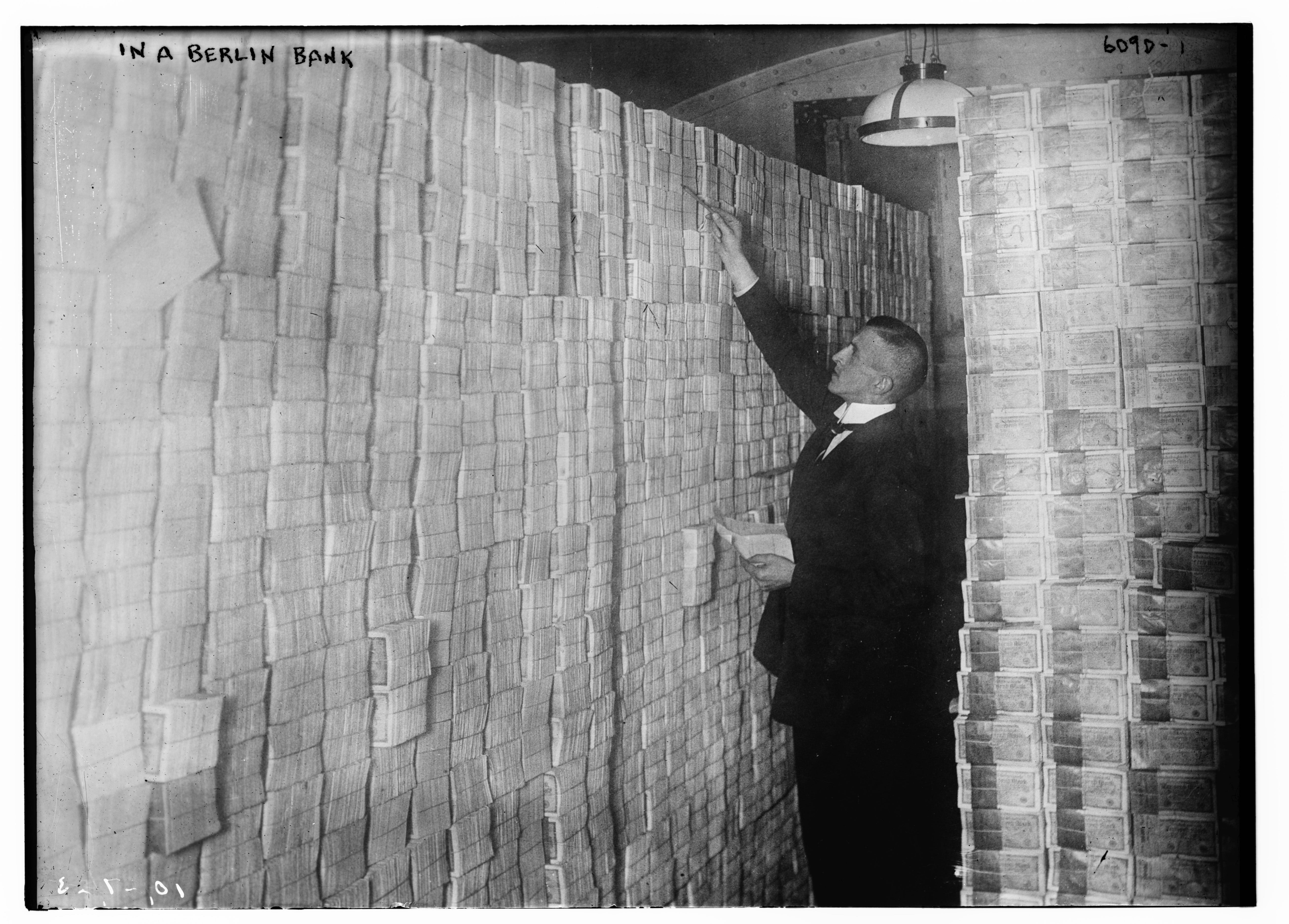
In this article, we will be learning about inflation: what it is, what causes it, what the appropriate responses are, and what the myths around it are that need to be undermined.
I want to say that I will be using the scalpel of reason to undermine those myths, but my alter-ego is telling me not to (because that’s just not funny Jim, so gie’s peace).
Ok, I won’t do that but what I will do is give this article some structure by splitting it into the following sections:
What is inflation?
How do we label the main types of inflation?
Why we must look at inflation sector by sector.
What does Modern Monetary Theory (MMT) bring to our understanding.
What are the myths and misunderstandings relating to inflation?
Step 1: What is inflation?
That’s easy: inflation is a continuous rise in the general price level (typically measured as a weighted average across a “basket of goods and services”).
The important word here is ‘continuous’. Inflation is not a one-off price increase.
If the price of eggs doubles once and then stays there, that’s simply a price increase.
But if, for example, wages continually increase as workers try to catch up with price increases and those wage increases push up prices even further we have inflation; a self-sustaining increase in prices.
Step 2: How do we label the main types of inflation?
The standard approach is to say that there are two types of inflation: demand side inflation and supply side inflation.
The classic (monetarist) description of demand side inflation is ‘too much money chasing too few goods’.
However, that puts the emphasis on money rather than resources: which from an MMT point of view, is the wrong way round.
A more appropriate description of demand-side inflation would be, ‘spending outpacing the economy’s capacity to produce’.
Think of a small town with only one butcher. If everyone suddenly has more money to spend and wants steak for dinner but the butcher can’t get more steak at short notice, he’s likely thinking, ‘hmm, I can get away with charging more for these steaks.’
Prices aren’t going up because there’s “too much money,” they are going up because the butcher hasn’t got enough steak to meet demand.
Supply side inflation is when the basic cost of creating goods and services goes up.
For example, when the price of oil increases that affects shipping prices and it affects energy prices. When the cost of doing business goes up that gets passed on to consumers at higher prices.
Learning the ‘demand-side’ versus ‘supply-side’ jargon is a good start, however, Economist John T. Harvey in his book ‘US Business Cycles 1954 - 2020’ points out that we need to take a much more nuanced approach. In the next step we’ll do just that.
Step 3: Why we must look at inflation sector by sector
In this section - as well as my more general comments - I will be summarising many of the points made by Harvey.
Harvey makes the following points.
We must take a more ‘nuanced approach’ to dealing with inflation.
Manipulating interest rates is never a good approach to managing inflation - except at the extremes.
Inflation isn’t always a bad thing.
Inflation produces winners and losers.
Ok, let’s look at these points in turn.
3.1 We must take a more ‘nuanced approach’ to dealing with inflation
As Harvey puts it, “inflation must be viewed as sectoral and not economy-wide if it is to be understood and addressed.” (p. 2.)
That seems obvious and of course it is: it is implicitly implied by the way that national statistics on inflation are compiled.
For example, in the UK the headline inflation figure is compiled by the Office for National Statistics (ONS) based on a representative “shopping basket” of goods and services (around 760 goods and services).
Some things are given more weight than others when calculating the final figure, for example, petrol or groceries carry more weight because these affect the prices consumers pay much more than other items in the list.
Similarly, Harvey teaches us that we must take a sectoral approach because each sector is unique; how we respond to inflation in each sector must also be unique.
3.2 Manipulating interest rates is never a good approach to managing inflation - ‘except at extremes’ (p. 35).
Here’s a question I’d like to ask the Governor of the Bank of England (BoE): why do you think that pushing up interest rates is a good way to address the fallout from conflicts in the Middle East?
Clearly putting up interest rates won’t bring down the cost of imported oil or sort the problems caused by the related disruptions (i.e.higher input costs for UK businesses).
And given that most of the inflation we’ve had in the last two decades has been supply-side inflation: why apply a solution whose logic has previously been justified on the basis that this is the best way to deal with demand-side inflation?
Why does the BoE put up interest rates to tame inflation, no matter the cause?
I suspect the number one reason is that changing interest rates is the only tool they have available: by ‘they’ I mean the BoE committee members.
Even if they agreed that fiscal policy is a more appropriate tool to use, fiscal policy is not under their control: so what are they supposed to do? Sit on their hands?
No, they see prices going up, they know everyone expects them to put up interest rates, so that’s what they do (they might as well do something while they are in the office).
So, that’s one reason. The other reason is, as I mentioned earlier, (perhaps) due to the deeply-engrained default thinking that workers must be ‘kept in check’ so they don’t go demanding wage rises that make the situation worse (my phrase not Harvey’s).
This is backed up by the belief that there is a trade-off between the level of unemployment and inflation and the idea that controlling inflation is assumed to be more important than workers losing their jobs.
Why do they think there is a tradeoff between the level of employment and inflation? Well if jobs are plentiful but workers are scarce, workers are in a position to demand higher wages: higher wages means higher prices.
How do you keep workers from demanding higher wages? Well, you break the economy (or as they would put it, they ’stop it overheating’) – to the point where workers may lose their jobs.
Why does the BoE want workers to lose their jobs (among other consequences of higher interest rates)? Well, because that will curb their negotiating power and lead to reduced wages.
However, as Harvey points out ‘except at extremes, interest rates are not a particularly efficient means of slowing economic activity’ (p. 35). So, the BoE might want to induce a recession but even that is not easy to do by manipulating interest rates.
That’s not to say it’s not possible: push interest rates up high enough (the ‘extremes’ Harvey mentioned) and you’ll manage it: Paul Volcker did just that: between 1979 and 1981 he caused the worst downturn since the Great Depression.
But outwith extreme circumstances, Harvey is right: manipulating interest rates is basically useless as a way to manage inflation.
As Phil Armstrong has been known to put it, (in relation to using interest rates to control the economy) is like trying to steer a car from the back seat (interest rates) by rocking back and forward on your bum cheeks - rather than by sitting up front and using the steering wheel (fiscal policy).
So, if pushing up interest rates doesn’t tame inflation - no matter what theoretical models are used to justify it - what does it do?
One thing we know is that high interest rates affect inequality. However, the effects are not simple. They make income inequality worse by pushing up mortgage or rent costs - and as mentioned earlier - risking job losses for lower earners. But at the same time, savers are earning a lot more on their cash.
However, high rates can lower wealth inequality by cooling down house prices and stock markets, shrinking the fortunes of the ultra-rich.
New on MMT101: MMT online training course – from first steps to advanced
If you want to learn MMT from the ground up, take my MMT online training course, MMT101 – The Why, The What and The How of Modern Monetary Theory. Paid subscribers get access at no additional cost – just message me.
3.3 Inflation isn’t always a bad thing
The next point Harvey makes, which again seems obvious once you say it, is that inflation isn’t always a bad thing.
For example,
“Rising prices are one of the means by which consumers can get producers to do what they want, that is, to sell more of the products they most desire.” (p.3.)
Rising prices act as a signal, telling producers where demand is strongest, so they know where to direct more resources.
That’s no bad thing – though, as we’ll see in our next step, that’s not to say everyone wins.
3.4 Inflation produces winners and losers
When oil prices go up, the income of those working in the oil industry also goes up. Inflation is redistributing wealth: we have losers (people paying more for the goods and services) but we also have winners.
What type of inflation are we dealing with?
And as Harvey points out, the right response to inflation depends on the needs of each specific sector, and the type of inflation we are dealing with.
He gives examples based on six varieties of inflation.
Demand-pull inflation: People want to buy more than businesses can actually produce, so prices get bid upwards.
Demand-pull inflation/labour market: The same bottleneck, but this time it’s workers who are in short supply rather than goods - so wages get bid up instead.
Cost-push inflation/market power: Firms with enough market muscle simply raise their prices to fatten their profit margins, whether or not their actual costs have gone up.
Cost-push inflation/supply shock: Something outside the economy entirely - a war, a bad harvest, a pandemic - pushes costs up regardless of what businesses or workers are doing.
Speculative: Prices rise because people are betting on a good, service, or related financial asset going up in value, and that betting itself becomes the thing driving the price higher.
Currency depreciation: When the pound (or dollar) is worth less against other currencies, everything we import costs more in our own money - so prices rise even though nothing about supply or demand at home has changed.
For each of these points he examines:
The cause of the inflation.
Where the inflation is concentrated.
Who wins and who loses.
The impact of rising prices.
And the appropriate policy response.
For example, when he examines the impact of the Russian invasion of Ukraine (under the category of ‘Rising Food Costs Due to Geopolitical Unrest) he makes the following points:
The cause of price rises is the interruption of food production and supplies.
Everyone loses.
The impact is that food prices go up.
The policy response would ideally be to end the war, but beyond that, the policy response should be to find or develop new food sources.
Given Harvey’s breakdown of the causes and appropriate remedies, it would be useful to look at what the US Fed actually did in response to those price hikes.
“What the Federal Reserve actually did, however, was raise interest rates in order to lower the overall level of demand. This in no way addresses the real problem – a food shortage – and, in fact, makes things worse.” John T. Harvey - US Business Cycles 1954 - 2020.
A second example, provided by Harvey (useful as a way to provide a contrast with the previous example) is demand-pull inflation, I.e. ‘prices are bid up because demand is outstripping producers’ ability to supply’ (p. 41).
The cause is a rise in consumer demand for some good or service.
The inflation is concentrated in the industry producing that good or service.
The winners are those supply those goods or services: with the extra income coming from those who drove the prices up because they desired those goods and services.
The impact is increased production and growth in that sector.
There’s no need for any policy response ‘unless some vulnerable group is being affected’ (p. 41) or this is happening in exceptional circumstances such as a war.
The rest of this section of Harvey’s book covers inflation-related topics including the ‘money growth cannot cause inflation’ (this is a must read section); why fiscal policy is more effective than monetary policy and a discussion of financial markets.
I’d love to write about all of these topics but I’d best stop here because the length of this article is growing at an alarming rate. For full details read Harvey’s book ‘US Business Cycles 1954 - 2020’. Go to the source rather than my summary.
Step 4: What is unique about the MMT approach to understanding inflation
Many of the following points flow from the following axiom: currency issuing governments like the UK and US can’t run out of the very thing they issue themselves.
When you have an equation with only two variables, money and resources and you know that one side of that equation is unlimited and the other finite, which one do you concentrate on?
You concentrate on the one that is potentially scarce - the resource side of the equation. When money is not scarce, the government’s job is to manage the limited resources that can be purchased with that money. The government must make choices about what to purchase, who to serve with that purchase, and to what end.
This tells us that inflation is a resource capacity problem not a money capacity problem. When a particular resource is scarce the price of that resource goes up.
Combine that with MMT insight on the role of taxes, i.e. taxes are a policy tool not a funding source.
As a policy tool taxation can be used to remove money from the private sector: reducing private spending power and tackling demand-side inflation. And if need be, freeing up space for additional government spending.
The Job Guarantee acts as a built-in stabiliser. Bill Mitchell points out that the fixed-wage, which is part of the MMT job guarantee policy combats wage inflation and makes it easier for employees to switch between jobs:
Rather than employers competing to attract “the best” workers with higher wages - seeing the long-term unemployed as too risky to hire - the Job Guarantee keeps people work-ready, with their skills and habits intact. That means employers are comfortable hiring at all skill levels, so they’re less likely to compete for the same narrow pool of workers and less likely to bid wages up to win them.
On the other side of the equation, workers are less likely to accept a wage below the Job Guarantee level, since a job at that rate - with benefits - is always available to them.
And the Job Guarantee prevents skill shortages during recoveries because workers remain employed, retaining their skills and work habits.
Like Harvey, MMT points out that manipulating interest rates is not a useful way to manage inflation. In fact, as Warren Mosler points out, increasing interest rates (i.e., increasing the price of money) is just as likely to have the opposite effect:
High rates increase business costs, and those costs are passed on to consumers in the form of higher prices.
Higher rates increase the savings of those who benefit from higher interest rates: which potentially increases demand as those with more money decide to spend some of it. That is, it is transferring income to savers, who then spend more, adding to demand.
And higher rates make mortgages more expensive, moving people away from ownership into renting and driving up rent prices.
Finally (for this section) - Mosler argues that the base price level is determined by what the government pays for the goods and services it buys. If the government decides to pay more or less for the resources it buys that redefines the value of its currency.
Step 5: What are the myths and misunderstandings relating to inflation?
When I originally decided on including this section I was only thinking of two things: the criticisms I get as an MMTer, and shooting down Friedman’s money-dropping helicopter (this is a reference to his famous ‘helicopter money’ thought experiment, where a central bank drops cash from the sky to show how printing money causes inflation).
However, once I looked into it, I found quite a few more myths to address. So, here - in summary - are myths and misunderstandings relating to inflation.
Myth 1: Growing the money supply causes inflation
The orthodox story goes: the central bank prints money, people spend it, and since the economy can only make so much stuff, prices get bid up.
There are several problems with this story.
First, the obvious one: the central bank, as Harvey points out, has no fiscal authority to print money - quantitative easing doesn’t result in money being spent into the private sector, it’s merely one asset (reserves) being swapped for another (government bonds).
Second, most broad money (commonly called the ‘money supply’) is largely created through commercial bank lending, not the central bank.
Third, Friedman assumes the economy is already operating at full capacity: if there was spare capacity in the economy, the extra spending would simply create more output and jobs, not higher prices.
Fourth, Friedman’s story isn’t backed by empirical data. As Harvey points out, it was never about “printing money” - the real risk is total spending outrunning what the economy can actually produce.
Myth 2: Government spending and deficits are inherently inflationary
This myth treats all government spending as equally dangerous. However, as Harvey points out; inflation isn’t economy-wide - it’s sectoral. The correct question to ask is: does spending in this sector outrun what this sector can produce?
MMT points out (with reference to Abba P. Lerner’s functional finance) that the size of the deficit isn’t what matters - what matters is whether the government is achieving its stated goals. For a currency issuer, the deficit is simply the resulting figure on the spreadsheet.
A deficit that stays within the economy’s spare capacity, sector by sector, won’t cause inflation. One that overshoots it will - regardless of the headline number.
However, the unspoken assumption is that inflation, and/or a non-inflationary deficit, should have a higher priority than employment or welfare. MMT points out that this is a choice, not an economic necessity.
Myth 3: We must choose between low inflation and low unemployment
This is the reasoning behind both the Phillips Curve trade-off (the idea that pushing unemployment up is the price you pay for pushing inflation down) and the central bank’s practice of raising interest rates to “cool” the economy.
However, as stated earlier in the article, except at extremes, interest rates are in practice a blunt tool for slowing the economy down - and the Phillips Curve isn’t backed up by consistent historical data (I say ‘consistent’ because it’s easy to pick a point in history that appears to verify the thesis).
So even if you accept the theory behind this trade-off, in practice it doesn’t work as advertised.
Myth 4: Wage rises cause inflation
This myth blames workers for “greedy” pay demands but it has the sequence backwards: demand-pull inflation in the labour market is just one example of inflation among many. In reality, wages catching up with prices is usually a symptom of inflation already happening in that sector, not the underlying cause. Blaming workers’ demands for inflation is, more often than not, an ideological stance, not an economic argument.
And the final myth is the one I hear most frequently, which is that “MMTers think that governments can spend, spend spend, blind to the fact that spending will cause inflation.”
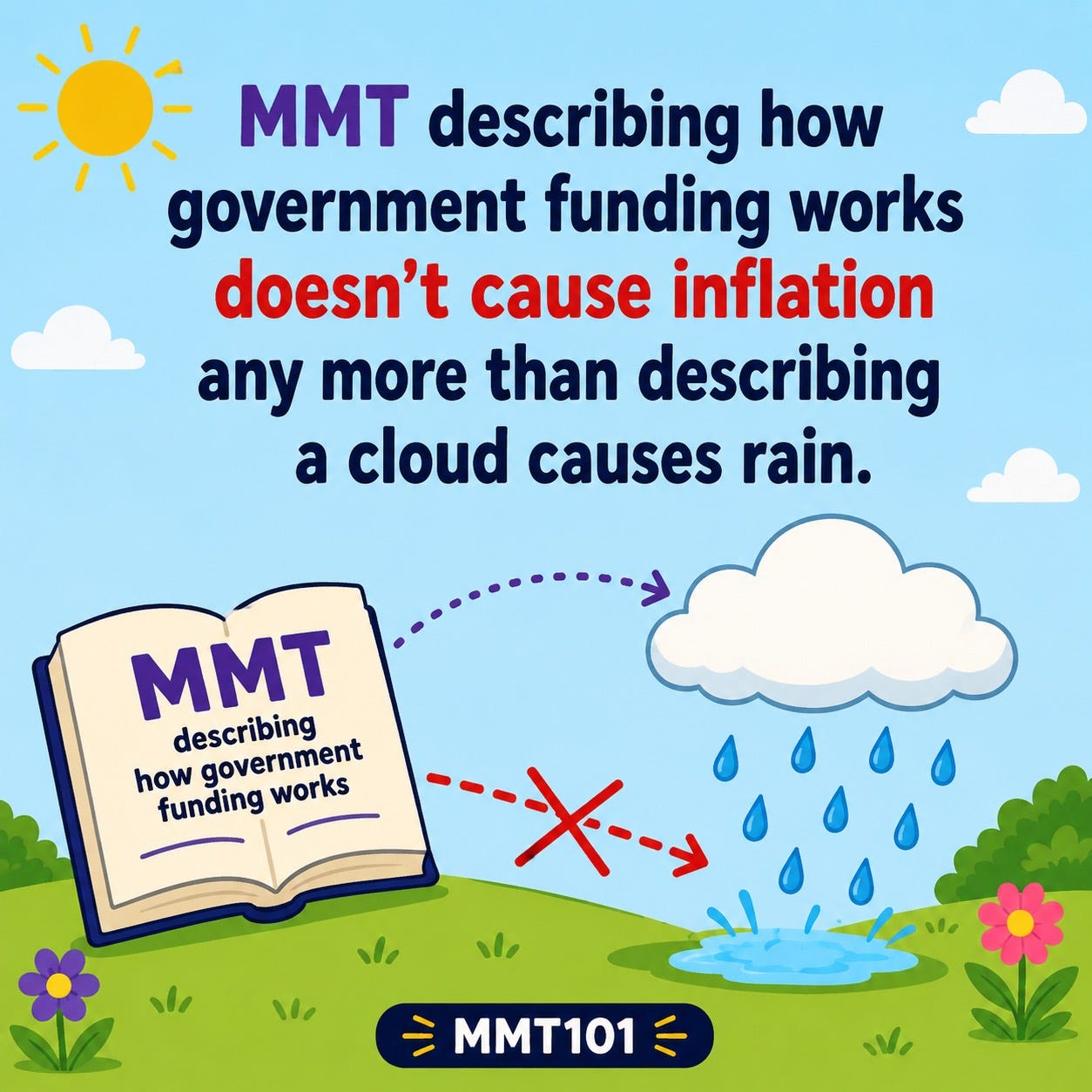
Luckily, that criticism is easy to respond to; MMT is principally a description of the monetary system including a description of the mechanics of government spending. A description of the system doesn’t cause inflation any more than describing a cloud causes rain.
Given MMT’s focus on resources rather than currency, MMT is actually more restrictive about spending constraints than mainstream economics, not less.
In fact, having an understanding of how government spending works gives the government an advantage. When you realise that your job is to manage limited resources rather than money you have a better chance of doing that job well.
In Conclusion: Understanding Inflation: Five Steps to Separating Myth from Reality
Phew! That was a longer article than I anticipated. I apologise for that.
We covered a lot of ground: we know what inflation is, why it’s a good idea to study it sector by sector, why the orthodox interest rates fix is no fix at all, what Modern Monetary Theory brings to the table that orthodox economics misses and why so many of the “obvious” things people say about the causes of inflation don’t survive contact with the evidence.
That’s all for now.
If you have any questions or if you disagree with anything I write, I want to hear from you. Please add your comments in the discussion area. Contrary views are welcome.
This newsletter has become my only work, and at the moment it isn’t paying enough to be sustainable. What I need now is for more people like yourself who are interested in economics and in particular MMT, to take the step of becoming paid supporters. For the cost a single cup of coffee a month you allow me to keep writing, keep teaching, and keep this project alive. Thanks.
Thanks to all of you who have helped to keep MMT101 going.

Resources
US Business Cycles 1954 - 2020 - John T. Harvey
Important Figures in the Development of MMT: Abba P. Lerner ‘Functional Finance’ - Jim Byrne
Job Guarantee: Where Did It Come From and What’s It For? - Jim Byrne
An example of the orthodox view of inflation: What is Inflation? Understanding Its Causes, Benefits, and Economic Impact - Marta Casanovas
A Framework For The Analysis Of The Price Level And Inflation - Warren Mosler
Regarding the Philips Curve: What Does Full Employment Mean? And Why At ‘Full Employment’ Are So Many People Still Looking For Work? - Jim Byrne
On MMT: Macroeconomics - Bill Mitchell, L. Randall Wray & Martin Watts
Links to some of my most popular newsletters
Become a paid subscribers for access to additional content:
A Permanent Home for MMT101 Paid Subscriber Resources – Factsheets, book recommendations, academic papers, MMT podcasts and more.
MMT Factsheet 3: If Taxes Are Not For Spending What Are They For?
Great piece, Jim. Very lucid - and your points are made very concisely, actually — despite the length of the article!
Jim, a question: when a government spends in excess of its revenue, is the deficit funded by borrowing money in the bond market, or is it provided by the central bank with no obligation to repay