
The Weimar Republic, Wheelbarrows of cash and The Real Causes of Germany’s Hyperinflation
How a supply-side catastrophe and foreign debts destroyed an economy – and why the printing press was a symptom, not the cause

If I wrote a 300,000 word book explaining the causes of inflation and posted a link to it on Twitter, what do you think the first comment would be?
It would be someone telling me that whatever is in my book is likely to be wrong, because the real cause of inflation is simple: governments printing too much money.
In their next tweet, they’d be telling me about the hyperinflation of the Weimar Republic in 1923 and likely throw in the name of Nobel Prize-winning economist Milton Friedman, just to add a bit of credibility.
What this tells us is that there are some stories about inflation that, despite being more myth than fact, are hard to eradicate.
They are like a virus that has made the jump from mainstream economists into the public sphere – like swine flu jumping from livestock to humans. Once established, they are very difficult to kill.
But luckily for us, there’s an antidote (for the economic myth, not the flu): historical facts and logic.
In this article, I will examine what actually caused the hyperinflation in the Weimar Republic and I will use historic data to undermine the ‘too much money printing’ (that sounds like a song title to me–perhaps an old blues from the 1920s) story.
And I will demonstrate that this so-called ‘money printing’ was not something unique to this period in history.
But first, let’s define what the myth is. It comes in many forms:
The Quantity Theory of Money; monetarism as promoted by Milton Friedman.
Too much money chasing too few goods.
The central banks printing too much money devaluing the currency. A story popular with those who promote cryptocurrencies.
The idea that governments must be disciplined by going back to the gold standard – because, by implication, they assume this would mechanically limit their spending (an illusion I will dismantle below).
In essence, these are all expressions that come from those who believe that inflation is ‘always and everywhere’ caused by central banks recklessly ‘printing’ money.
I’ve already examined what inflation is and what causes it, in another article (you will find it in Understanding Inflation: Five Steps Separating Myth from Reality) – so there’s no point in me repeating that.
Instead, I’m going to look at the validity of the ‘Weimar Republic, hyperinflation, wheelbarrows of cash, aspect of this story.
[The Weimar Republic is the name historians give to the German state during this period (1919-1933), however, for clarity and brevity, from now on I’m just going to refer to Germany.]
Let’s get started.
The Treaty of Versailles and Germany’s post-war obligations
First, we need some context. After Germany’s defeat in the First World War, the Allied Powers drew up the Treaty of Versailles, designed, among other things, to force Germany to pay ‘reparations’ for the damage it had caused during the war.
And crucially (for what followed), those reparations had to be paid in gold or gold-backed foreign currency.
This meant the government had to find ways to meet its obligations: initially by depleting its gold reserves, then by obtaining foreign currency through export earnings and the foreign exchange market and by settling in kind (i.e. handing over physical goods and commodities).
Unfortunately for the citizens of Germany, the government was being forced to do this just at the point where the country had lost a huge chunk of its industrial capacity.
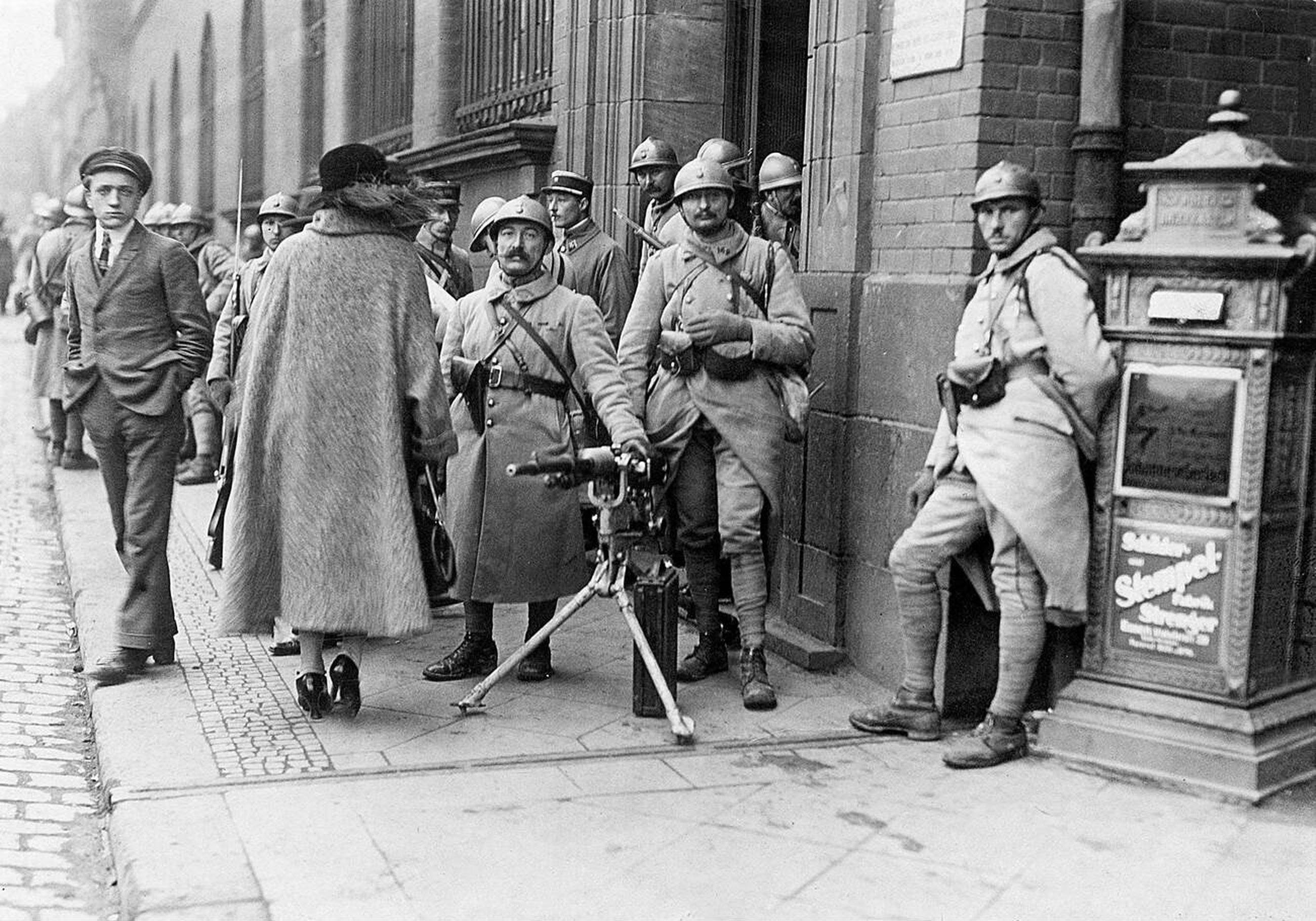
This was a problem exacerbated by France and Belgium occupying the Ruhr in 1923, taking over Germany’s coal and steel production.
“In January 1923, French and Belgian troops crossed the border and occupied numerous points in Germany’s Ruhr Valley. The Ruhr occupation would last more than two and a half years.” Alpha History – The Ruhr occupation
Clearly some pretty bad things are happening to Germany at this point in history. But what we want to know is how these problems lead to hyperinflation?
Let’s examine two contributing factors:
Currency depreciation.
The collapse of Germany’s domestic economy.
Depreciation of the German Mark
As indicated above, Germany, having exhausted its gold reserve, was in a position of having to purchase foreign currency, for payment of reparations.
But it was faced with a market that was not too keen on taking its currency. [Understandable, given the circumstances. Though on a different note – it does reveal a degree of muddy thinking – from those who drew up the treaty.]
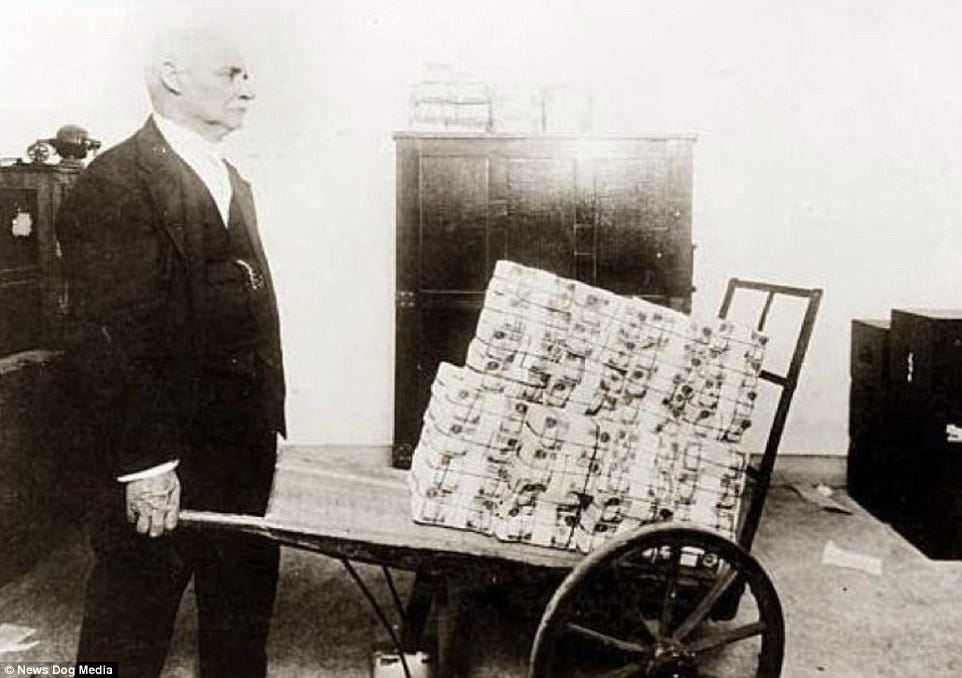
It’s no surprise therefore that the value of the Mark crashed (statistics are sourced from Encyclopaedia Britannica and Imperial Statistical Office):
In 1914, it took 4 Marks to buy $1 of imported food. By November 1923, it took 4,210,500,000,000.
In June 1922, the cost of living index was 41–but within six months it rose by more than 16 times.
The price of food in Germany multiplied by 100.
In short, the cost of living in Germany shot up.
And, as we see in the next section, the country’s problems were compounded by what was happening in its domestic economy.
[Note, that there were other pressures acting upon prices, including interest rate hikes: which as Mosler & Armstrong point out, ‘intended to support the mark instead worked to exacerbate the inflation’. This was due to the additional interest income, and ‘future pricing’, where ‘prices increased in line with interest rates’ (Weimar Republic Hyperinflation through a Modern Monetary Theory Lens, p. 1 - Phil Armstrong and Warren Mosler)]
Germany’s domestic economy crashes
France and Belgium (who were convinced that Germany had the money to pay but were holding back) had occupied the Ruhr valley, Germany’s industrial heartland, to secure their share of reparations – via physical resources.
The German Government, having no military power to resist, asked German workers (via the unions) to refuse to co-operate with the occupiers. To keep workers on their side (and alive) it paid the wages of striking workers.
However, by this point, workers had virtually nothing to spend their money on: goods were scarce, forcing up prices even higher.
So, we have a perfect storm: a devalued currency making imports impossibly expensive combined with a collapsing domestic economy.
An examination of the phrase ‘printing money’
In my next section I’m going to examine the idea that Germany experienced hyperinflation because of – the implied assumption – that it suddenly discovered deficit spending after World War I.
But before that I need to define the phrase ‘printing money’, a derogatory term commonly used to indicate a government being profligate with its spending.
In short, in the context of governments who fund a fiat currency, printing money is a euphemism for ‘running a deficit’. That is, the government is spending more than it is bringing in through taxes.
The assumptions underlying this phrase are that this is an unusual, (immoral?) dangerous action that can only lead to bad consequences - such as inflation - or even hyperinflation.
But in simple terms (and ‘printing money’ is a deliberately simple phrase), the phrase refers to government spending more than tax ‘income’ – whether the government is using a gold standard or a fiat currency system.
[I explain what a fiat currency is in my article, MMT Fundamentals: A Fiat Currency - What Is It and Why Is It Important?
And for those who are thinking that I’m wrong about this simple definition because they believe Quantitative Easing (QE) adds money to the private sector or that bond sales provide the government with money to offset a deficit, read my articles, Quantitative Easing (QE) Explained: What It Is, What It Isn’t and Killing the Myth of Government Borrowing Stone Dead: Gilts, T-Bills, Interest Rates and the Truth About Money Printing.]
In my next section I demonstrate that running a deficit was not unique to Germany.
In fact it is normal behaviour for all countries and always has been. For example, the UK has been running a deficit for most of the last 300 years - as we can see from the graph below.
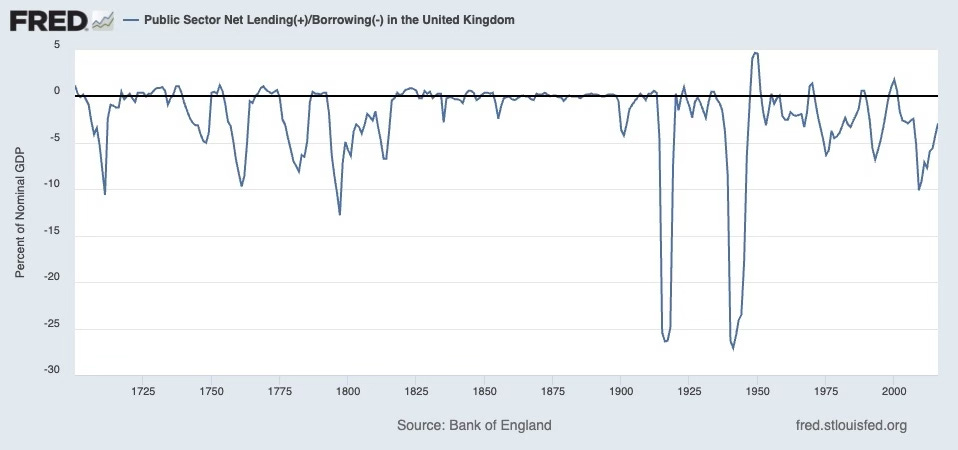
In the next section I will examine the period from when Germany became a unified state up until the end of World War One - to demonstrate this point

Deficit Spending in Germany from 1871 thru to 1923
As we can see on the two graphs below, Germany had been running deficits since its inception in 1871 and running an even larger deficit from the start of the First World War.
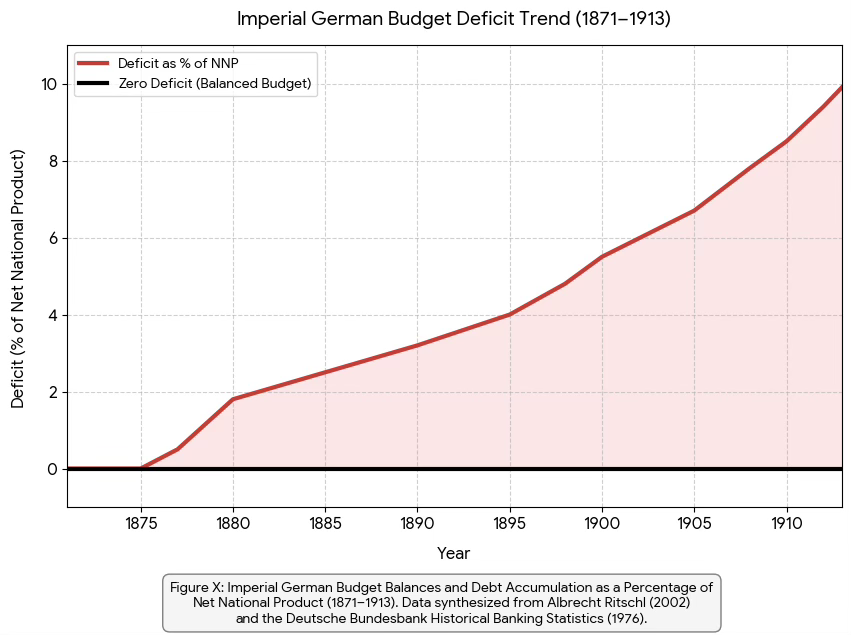
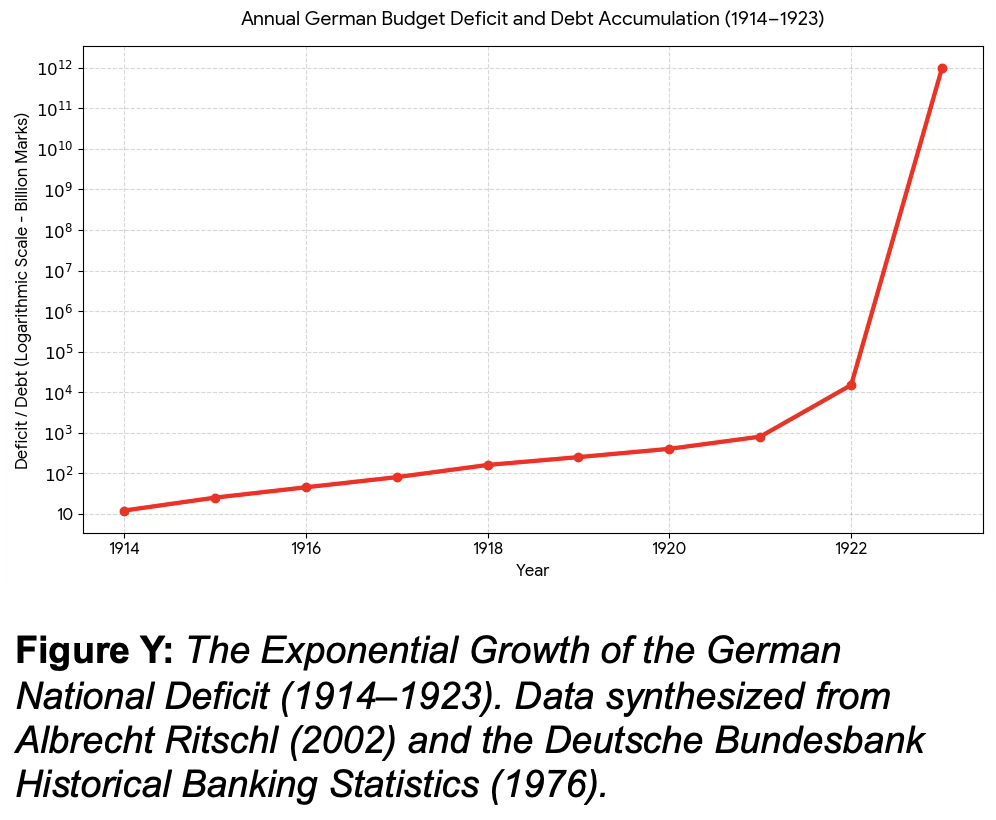
I have separated these graphs out because if I put them both on the one graph the figures prior to 1914 would be so small that it would look like a straight line when compared to what followed.
I’m discussing this period in Germany’s history, to demonstrate the idea that this ‘money printing’ was not the novel anomaly that commentators (and Tweeters) try to make out.
I have split Germany’s currency operation into three eras: between 1871 (when Germany became a unified state) and 1913, between 1914 and the end of the First World War and after 1918, as the German economy collapsed and we see the appearance of hyperinflation.
The Early Years (1871–1913): The Gold Standard Illusion
When Germany first became a unified country in 1871, it operated on the Gold Standard.
This was a period of time when the central government was boxed in by its constitution: direct income tax powers still belonged to individual states.
And yet, it needed to fund a huge expansion of its national infrastructure and institutions (including a national navy and army) in order to create a single functioning country from the previously independent states.
To do this, it needed to run a deficit: it had a restricted tax income (for example, indirect taxes and customs duties) and, therefore, had to ‘borrow’ to fund that deficit.
However, this ‘borrowing money’ story is much more like the modern ‘borrowing’ than we might think.
What is happening is that private bank reserves are being swapped for government bonds.
[Note: even quantitative easing - often called ‘money printing’ - is really just an asset swap, bonds for reserves, with nothing new created in net terms. Deficit spending, bond-financed or not, is what actually adds new financial assets to the economy - and that was true in 1871 just as much as 1923.]
The added complexity is simply that the total amount of currency they could choose to issue into the system was constrained by a self-imposed limit: that limit being the one-third ratio against the gold the government had in its reserves.
Note that I’m using the word reserves, when in reality the system was different in the late 19th century: the private banking system actually held physical legal tender notes and gold-backed coins. Those ‘reserves’ were not held in digital central bank accounts.
And, for anyone thinking it’s impossible to run a deficit on the gold standard (because all spending has to be backed by gold), Germany’s gold standard did not mean every paper Mark issued had to be fully backed one-for-one by gold in the vault.
And as I’ve mentioned above, Germany’s gold standard did not require every Mark in circulation to be backed one-for-one by gold. The system allowed the Reichsbank to issue notes in excess of its gold holdings.
1914: coming off the gold standard
When World War I broke out in 1914, Germany was forced to come off the gold standard; the cost of fighting an industrial war was far higher than could be accommodated by how much gold was sitting in its vault.
So at this point Germany was running a fiat currency.
In effect, that just meant that it stopped pretending that what it could spend was limited (by the amount of gold in the governments vault), and it became more obvious that its limits were defined by the real resources available: soldiers, steel, factories and so on.
But we can note that, in purchasing those resources, it was running a massive deficit – as shown in the graph from 1914 through to 1923.1
The 1923 collapse that led to hyperinflation
As I pointed out in my introduction, there is a widespread belief that the catastrophic hyperinflation of 1923 happened simply because the government “printed too much money.” And it was this that led to people needing ‘wheelbarrows of Marks to buy bread’, etc.
However, as I have shown, that inflation was largely due both to a collapse of real production (French and Belgian troops marched in and occupied the Ruhr Valley) and a catastrophic devaluation of Germany’s currency – due to reparations having to be paid in a currency it didn’t issue.
The reality of this story is that hyperinflation wasn’t triggered by demand; it was triggered by skyrocketing costs and a severe supply-side collapse. The initial catalyst for those Increases came from Germany’s currency devaluation, which in turn was triggered by the nature of the treaty obligations.
It is true that Germany issued its own currency as a result of the problems it found itself in. But, hyperinflation was a reaction to real problems: ‘printing money’ was not the cause.

In conclusion – ‘printing money’ was not the cause of Germany’s hyperinflation
In undermining this particular myth (or should I say virus), I’ve made three points. The first two are directly related to the causes of Germany’s hyperinflation:
The catastrophic devaluation of the German Mark was an inevitable consequence of the terms of the Treaty of Versailles. MMT tells us: countries must avoid building up debts in a currency they don’t issue themselves. Why? Well because obtaining that currency drains foreign currency reserves, puts downward pressure on the value of the domestic currency and that leads to imported inflation. In this case - a massive devaluation led to massive inflation. In Germany’s case, of course, it wasn’t a foreign debt that forced them to seek foreign currency, it was the imposition of reparations. However, the result is the same.
The combination of an already weakened German economy and the takeover of Germany’s industrial heartland led to a collapse of the domestic economy. Goods became scarce but workers had money in their pockets to spend. Trying to buy scarce resources pushes up prices.
In my third point I moved away from the causes of Germany’s hyperinflation to address the use of the phrase ‘printing money causes inflation’. I have included this to demonstrate why this idea is a red herring.
Put simply, ‘printing money’ is nothing more than a description of how most currency-issuing countries behave, most of the time.
That is, they issue their own currency, run deficits and build up ‘debts’ in that currency.
History shows that the size of a debt in a currency you issue yourself has no impact on the government’s ability to continue to issue its own currency. The impact is limited to, among other things: the effects of the interest payments; private sector wealth (and inequality); interest rates and expectations.
Germany’s problems came not from issuing its own currency but from having to pay reparations in a currency it did not issue itself.
And, Germany’s hyperinflation was a story about the collapse of that currency, at the same time as the economy itself was collapsing. The Reichsbank’s printing presses were a reaction to that collapse, exacerbating what was happening, but not the cause.
That’s all for now.
If you have any questions or if you disagree with anything I write, I want to hear from you. Please add your comments in the discussion area. Contrary views are welcome.
This newsletter has become my only work, and at the moment it isn’t paying enough to be sustainable. What I need now is for more people like yourself who are interested in economics and in particular MMT, to take the step of becoming paid supporters. For the cost a single cup of coffee a month you allow me to keep writing, keep teaching, and keep this project alive. Thanks.
Thanks to all of you who have helped me to keep MMT101 going.

Resources
Weimar Republic Hyperinflation through a Modern Monetary Theory Lens (2020) - Phil Armstrong and Warren Mosler
Understanding Inflation: Five Steps Separating Myth from Reality – Jim Byrne
A Fiat Currency - What Is It and Why Is It Important? – Jim Byrne
The Treaty of Versailles (1919), Part VIII: Reparations - See Article 232 and Annex II mandated that Germany make payments in gold marks, gold-backed foreign currencies.
Encyclopaedia Britannica: Weimar Republic in The Ruhr and inflation Years of crisis (1920–23). For exchange rate and cost of living statistics - along with the reference below.
Ritschl, Albrecht (2002), Deutschlands Krise und Konjunktur 1924–1934. Forcing a domestic currency issuer to settle obligations in foreign currency created an insurmountable ‘short position’ on the German Mark. Data and translation via Google.
Weimar hyperinflation: some lessons to be learned (2022) – Alan Grandjean and Laurent Hutinet. From The Other Economy.
The Ruhr occupation – Alpha History
Wikipedia: Hyperinflation in the Weimar Republic Statistics.
Weimar Republic Hyperinflation through a Modern Monetary Theory Lens (2020) published by the Global Institute for Sustainable Prosperity
Germany’s 1875 Banking Act and the genesis of a monetary framework: 1866-76 – Klaus, Hendrik. The statute dictated that the central bank was only required to back one-third of its circulating paper currency notes with physical gold or highly secure reserves.
World War I German Emergency Money - American Numismatic Association. For information on the suspension of gold standard.
Links to some of my most popular newsletters
Become a paid subscribers for access to additional content:
A Permanent Home for MMT101 Paid Subscriber Resources – Factsheets, book recommendations, academic papers, MMT podcasts and more.
MMT Factsheet 3: If Taxes Are Not For Spending What Are They For?
Like the UK, the German government issued war bonds during this period, offsetting some of its spending into the private sector - a way of controlling inflation by draining excess liquidity from the public’s pockets.
I'd like to add Karl Polany: The Great Transformation.
Excellent lesson, Jim! Thank you for the education.